
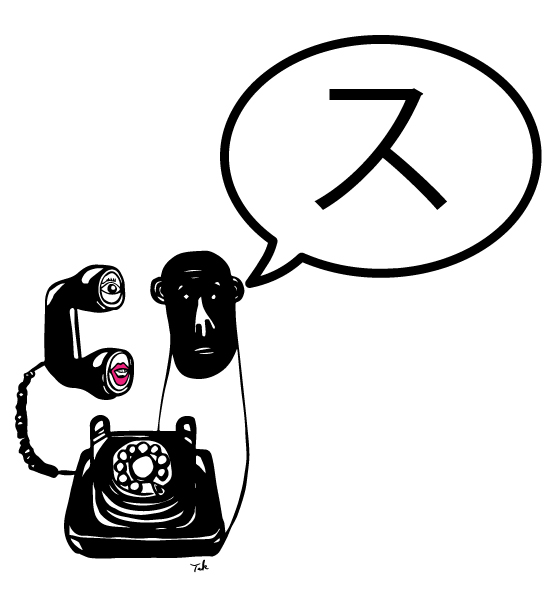
Japanese sa shi su se so. Katakana sa shi su se so.
Katakana itself is a Japanese-unique script, so it's good to learn it. However, I sometimes feel that the 'restriction' of always using katakana for foreign words is no longer necessary. From childhood, we are drilled in elementary schools with tests on these katakana words, being told 'this is correct, this is incorrect,' so I think there are cases where the gap in sound and meaning that doesn't convey properly remains ingrained.
For example, the 'sa' row. In the ABC song, it's A, B, C. We fail immediately at the third one.
So, what should we do? We often discuss this as a family. I think, 'Well, isn't alphabet okay then?' But taking a step back, the solution within the constraint of katakana notation is to pronounce it starting with 'Su'.
The ABC song. A, B, 'Suu'. Ebisu. First, force your mouth into a 'Suuuuu' shape, and then pronounce it. Everyone should be able to pronounce SWIMMING, so using that as a reference to say 'Si' should work.
A, B, 'Si', D, E, F... With this, we can conquer the difficult 'C'!
For example, once you get used to it,
'See you later' vs 'Sii you later'
Please do try practicing the pronunciation. It should be quite effective.
Incidentally, due to the difference in conveying meaning
There are also some dangerous ones,
There are reasons why I recommend 'Sii'...
SHIT DOWN (X) = Means to defecate
SIT DOWN (O)
A slightly advanced mistake of reversing sounds... This is something I actually got wrong. The pattern of reversing 'shi' and 'si', I was so conscious of it that I ended up not knowing which was which. At school, the teacher (female) assigned a lot of homework, so I wanted to use the newly learned word 'pushy' to describe her as a strong-willed teacher (though there was no need to use it in that situation), intending it as a joke... Pushy vs Pussy (a derogatory term for women)... The class went silent...
By the way, the same applies to za, ji, zu, ze, zo.
ZIPPER: Jippaa (X)
ZIPPER: Zipper (O)
For those who have become too accustomed to katakana notation, I highly recommend trying the 'Su' replacement. That was the story.